Category guide · Updated July 12, 2026
Benefits Administration Platform Guide for 2026
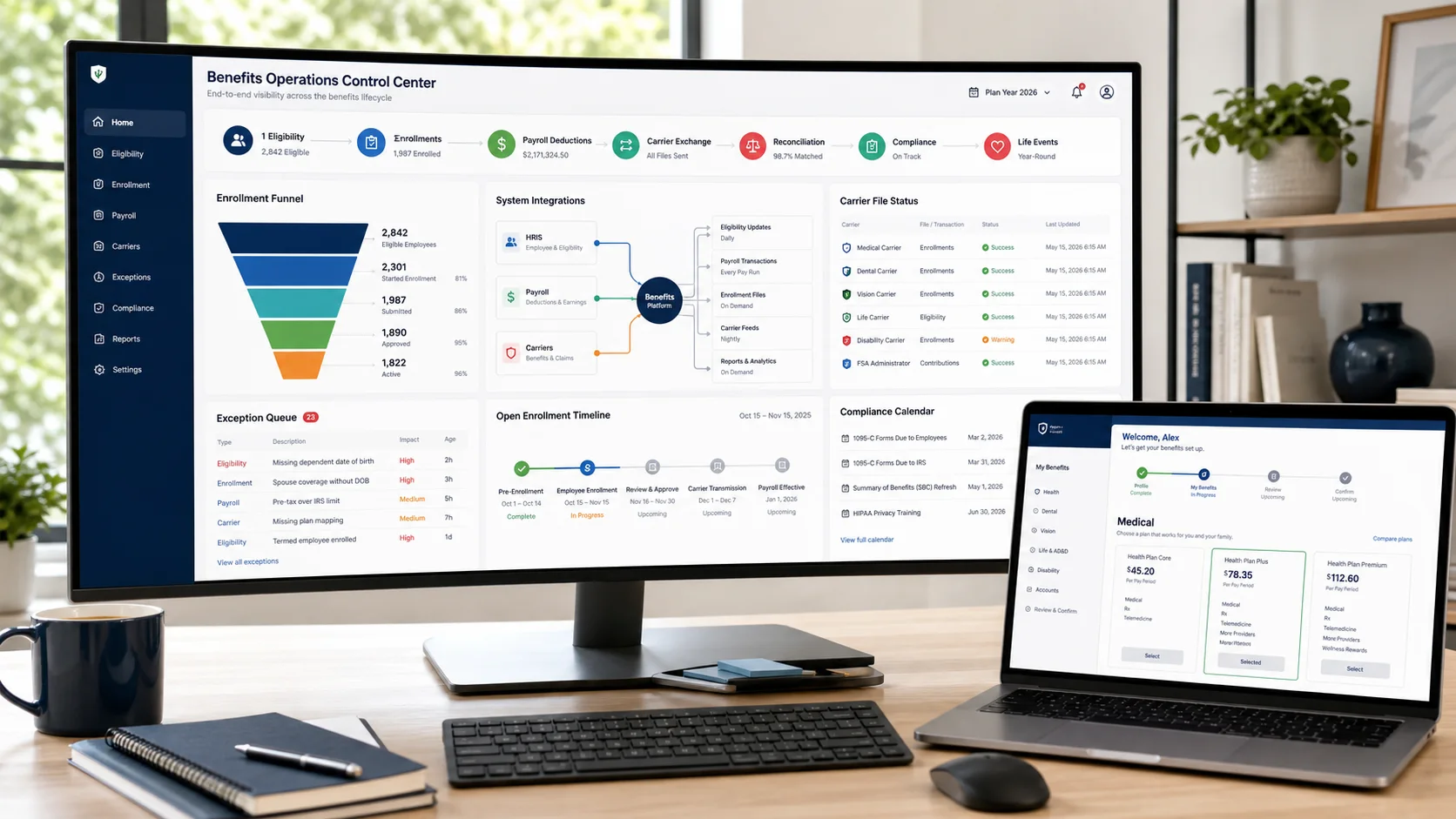
A benefits administration platform is the operating layer between employee data, plan rules, enrollment, payroll deductions, carriers, and compliance records. This guide maps that lifecycle so HR teams can define requirements, test vendors, and prevent enrollment data from breaking between systems.
Looking for ranked products and current prices? This page covers category architecture and buying requirements. Use the separate comparison for product recommendations.
Compare 5 platformsWhat Benefits Administration Software Owns
Ben admin software should create one controlled workflow from eligibility through carrier confirmation. The platform does not have to be the master record for every field, but it must make ownership, timing, errors, and approvals visible.
Employee and dependent data
Establish the HRIS source of truth for status, location, hours, class, dependents, and qualifying events.
Eligibility and plan rules
Configure waiting periods, classes, contribution rules, plan availability, evidence, and effective dates.
Enrollment and decision support
Guide employees through elections, waivers, dependents, beneficiaries, documents, and plan comparisons.
Payroll deductions
Translate elections into pre-tax and post-tax deductions, employer contributions, and effective payroll dates.
Carrier and vendor exchange
Transmit enrollments, changes, terminations, and contributions through API, EDI, or managed files.
Reconciliation and exceptions
Compare platform, payroll, carrier, and invoice data; assign errors and document corrections.
Reporting and compliance support
Produce required data, notices, audit trails, and reports while keeping ownership explicit.
Year-round life events
Process hires, terminations, marriage, birth, address changes, leave, COBRA, and plan updates.
Five Benefits Platform Models
Vendor comparisons fail when a payroll module, dedicated benefits platform, PEO, navigation tool, and TPA are treated as if they sell the same outcome. Start by selecting the operating model.
| Platform Model | Primary Ownership | Best For | Proof to Request |
|---|---|---|---|
| Payroll or HCM suite | Employee record, payroll deductions, and a benefits module | Small and midsize teams that want fewer systems | Confirm carrier exchange depth and whether the benefits module is native or partner-delivered. |
| Dedicated benefits administration platform | Enrollment, eligibility, carrier exchange, communications, and benefits data | Complex plans, many carriers, or larger benefits programs | Inspect configuration, integration, reconciliation, case-management, and service capacity. |
| PEO or outsourced administration | A broader HR, payroll, benefits, and compliance service under contract | Employers that want benefits access and more administrative support | Separate the PEO fee, premiums, co-employment duties, service scope, and termination obligations. |
| Benefits navigation and decision support | Employee guidance before and after enrollment | Employers that already administer plans but need better understanding and utilization | Verify plan-level accuracy, provider data, cost estimates, escalation, and year-round engagement. |
| Point solution or TPA service | A defined function such as COBRA, FSA/HSA, ICHRA, billing, or leave | Programs with a specific administration gap | Document the handoff to payroll, carriers, brokers, and the core ben admin platform. |
Current Platform Examples
These examples are not a ranking. They preserve the page's original platform set and show why pricing only makes sense after the service model is clear. For recommendations, use the ranked benefits software comparison.
| Example | Model | Current Pricing | Use When | Watch For |
|---|---|---|---|---|
| Gusto | Payroll-led benefits administration | Simple $49 + $6/person; Plus $80 + $12; Premium $180 + $22 | Payroll is the system of record and the employer wants benefits enrollment and deductions in the same SMB platform. | Plan availability, broker-integration eligibility, and add-on costs for tax-advantaged accounts or other benefits. |
| Justworks | PEO benefits administration | PEO Basic $79/employee; PEO Plus $124/employee per month | The employer wants payroll, HR, compliance support, and access to medical, dental, and vision through PEO Plus. | Insurance premiums and add-ons are separate from the published PEO administration fee. |
| TriNet | PEO or service-backed HR platform | Custom per-employee quote | The employer needs PEO-sponsored benefits or wants an HR platform with optional administration services and expertise. | TriNet PEO, HR Plus, and HR Platform are distinct models with different ownership and service boundaries. |
| BenefitFocus | Dedicated benefits administration platform | Custom enterprise quote | Enrollment, communications, HCM/payroll integrations, carrier data exchange, and year-round administration are complex. | Price implementation, integration, service, data-exchange, and optional decision-support scope as separate workstreams. |
Pricing checked July 12, 2026. Insurance premiums, implementation, carrier connections, optional services, and negotiated terms can materially change total cost.
Integration Architecture
The benefits platform should document which system creates each field, how often it moves, what happens when a record fails, and who resolves the exception. Ask for an object-level data map rather than a logo page of integrations.
HRIS or HCM
Employees, dependents, status, class, location, hours, dates, and life events
Payroll
Deductions, employer contributions, taxable treatment, effective dates, and retroactivity
Carriers
Enrollment adds, changes, terminations, evidence, acknowledgements, and rejection details
Benefits vendors
Retirement, FSA/HSA, COBRA, leave, disability, voluntary benefits, and point solutions
Identity and security
Single sign-on, role provisioning, least privilege, termination, and audit records
Analytics
Enrollment, contribution, invoice, utilization, case, and exception data for reporting
ACA Enrollment and Compliance Ownership
ACA enrollment software can track eligibility, offers, elections, coverage, and reporting data, but it does not remove the employer's need to confirm who reviews and files each requirement. Applicable Large Employers generally use Forms 1094-C and 1095-C for required offer and coverage reporting.
Federal COBRA generally applies to private-sector group health plans maintained by employers with at least 20 employees on more than half of typical business days in the prior year. State continuation rules can apply below that threshold. ERISA plan documents and disclosures, Section 125 documents, HIPAA duties, and state mandates need the same explicit ownership.
Benefits Administration RFP Scorecard
A useful RFP asks vendors to prove workflows with your data patterns. Score the result of a scripted test, not a polished generic demonstration.
| Requirement | Evidence to Request | Scripted Test |
|---|---|---|
| Eligibility configuration | Rule inventory and configuration workbook | Run employees across classes, locations, hours, waiting periods, and effective dates. |
| Payroll integration | Supported objects, direction, frequency, and error handling | Compare elections, deductions, employer contributions, and retroactive changes. |
| Carrier data exchange | Carrier-specific API, EDI, and managed-file catalog | Trace an add, change, termination, dependent update, and rejected transaction. |
| Open enrollment | Project plan, communication tools, load tests, and support model | Simulate plan comparison, waiver, dependent evidence, confirmation, and deadline reminders. |
| Exception management | Queue ownership, severity rules, service levels, and audit log | Introduce a missing identifier, invalid date, carrier rejection, and deduction mismatch. |
| Compliance responsibilities | Contracted RACI for ACA, COBRA, ERISA, Section 125, HIPAA, and state rules | Name the responsible party, approver, data source, deadline, and proof for each deliverable. |
| Security and data handling | Security reports, access model, encryption, retention, subprocessors, and incident process | Review least-privilege roles, termination access, exports, support access, and deletion workflow. |
Implementation Workstreams
Do not commit to an implementation date until the carrier, payroll, eligibility, security, and compliance dependencies are inventoried. Organize the project around proof gates.
- Discovery: inventory plans, classes, vendors, carriers, payroll groups, eligibility rules, and current exceptions.
- Data design: define sources of truth, field mappings, identifiers, effective dates, retroactivity, and history.
- Configuration: build plans, contributions, communications, workflows, roles, and approval controls.
- Integration testing: test adds, changes, terminations, dependents, deductions, rejections, and reconciliation.
- Enrollment readiness: validate plan documents, decision support, employee communications, support staffing, and escalation.
- Cutover: reconcile every active election and deduction, retain audit evidence, and define rollback ownership.
- Steady state: run daily exception queues, payroll checks, carrier reconciliation, invoice review, and service reporting.
How to Compare Total Cost
Build a three-year cost model that separates insurance premiums from administration. Include platform and per-employee fees, implementation, integrations, carrier connections, open-enrollment support, COBRA and spending-account services, data conversion, custom reports, support tiers, and exit fees. For a PEO, include the complete administration fee and contractual treatment of benefits and payroll services.
Then price the internal work that remains: eligibility exceptions, payroll corrections, carrier reconciliation, employee cases, invoice review, and compliance approvals. A lower license price can be more expensive if those queues stay manual.
Frequently Asked Questions
What is a benefits administration platform?
A benefits administration platform centralizes employee eligibility, plan setup, enrollment, dependent and beneficiary data, payroll deductions, carrier exchange, communications, life events, reporting, and year-round benefits records.
What is ben admin software?
Ben admin software is shorthand for benefits administration software. The term can describe a module inside payroll or HCM, a dedicated enrollment platform, a PEO technology layer, or a point solution for functions such as COBRA or spending accounts.
What should ACA enrollment software support?
ACA-related software should track employee status, eligibility, offers of coverage, enrollment, affordability inputs, and the data needed for Forms 1094-C and 1095-C where applicable. Employers should still confirm who reviews and files each deliverable.
How much does benefits administration software cost?
Pricing varies by service model. Common components include a platform subscription, per-employee fees, implementation, carrier connections, payroll or HCM integrations, COBRA or spending-account administration, support, and insurance premiums. A PEO fee is not directly comparable with software-only pricing.
What systems should integrate with a benefits administration platform?
The core integration map usually includes HRIS or HCM, payroll, insurance carriers, retirement and spending-account vendors, COBRA or leave administrators, brokers, identity providers, data warehouses, and employee communication channels.
How is this guide different from a benefits software ranking?
This pillar explains the category, operating model, integrations, compliance ownership, implementation, and RFP tests. The separate ranked comparison evaluates named products, current prices, and best-fit scenarios.
Related Guides
Primary Sources
Product and government sources were checked July 12, 2026. Validate current contract scope and legal requirements before purchase or filing.
- Gusto official product or pricing page
- Justworks official product or pricing page
- TriNet official product or pricing page
- BenefitFocus official product or pricing page
- IRS Form 1095-C guidance
- U.S. Department of Labor employer COBRA guide
- U.S. Department of Labor benefits laws and regulations
Affiliate disclosure: We may earn commissions when you click partner links, at no extra cost to you. Our reviews stay editorially independent.